
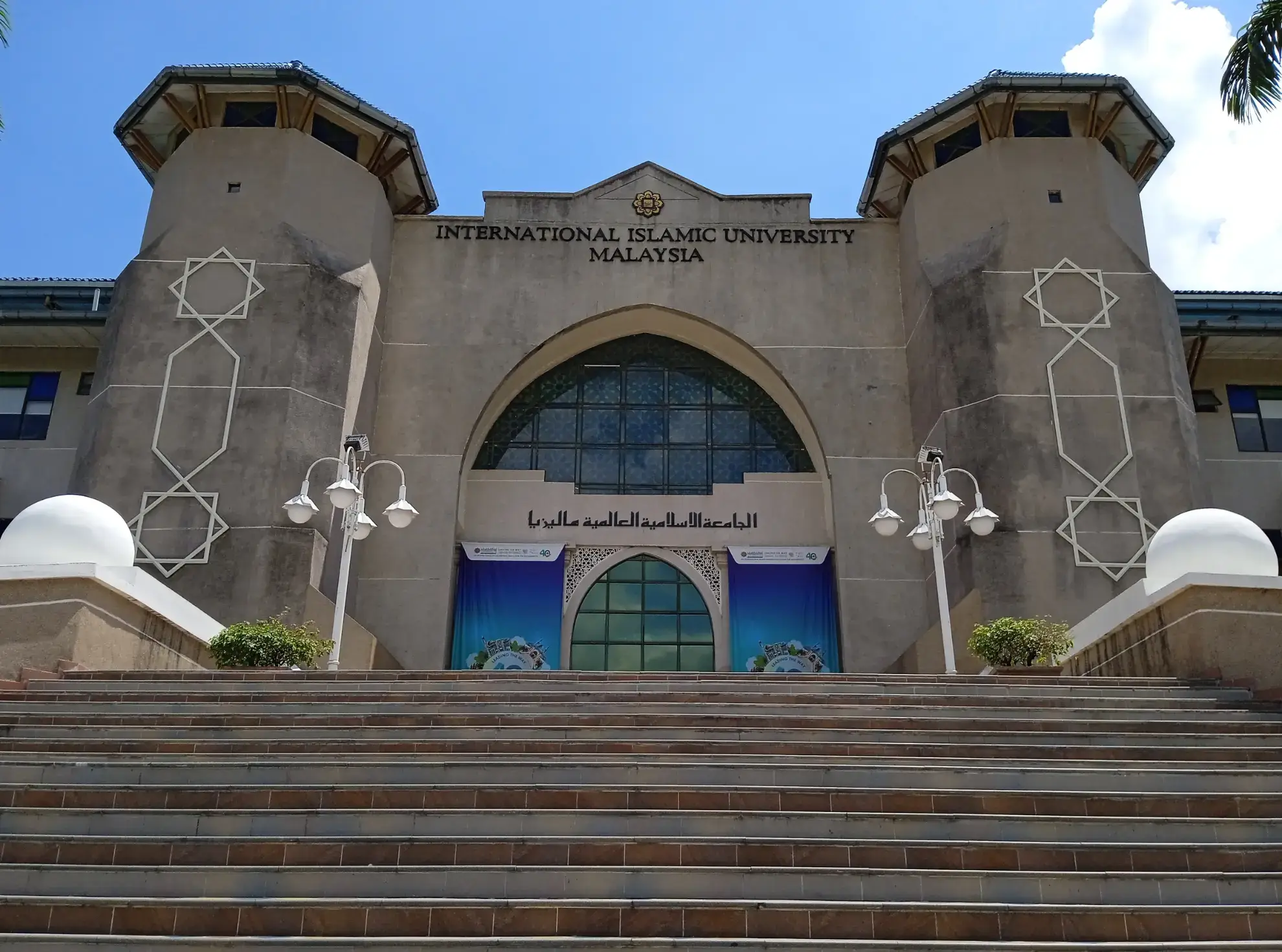
Choosing the right university and program is one of the biggest decisions you’ll make as an international student. If the International Islamic University Malaysia (IIUM) is on your radar, you’re probably searching for a reliable IIUM course list, wondering which IIUM courses match your career goals, and trying to figure out how the application process works.
This complete guide to IIUM courses covers every program across all 14 Kulliyyahs (faculties), along with admission requirements, tuition fees, and a step-by-step walkthrough of how to apply — especially if you’re an Indian student exploring IIUM courses for the first time.
What Makes IIUM Stand Out Among Malaysian Universities?
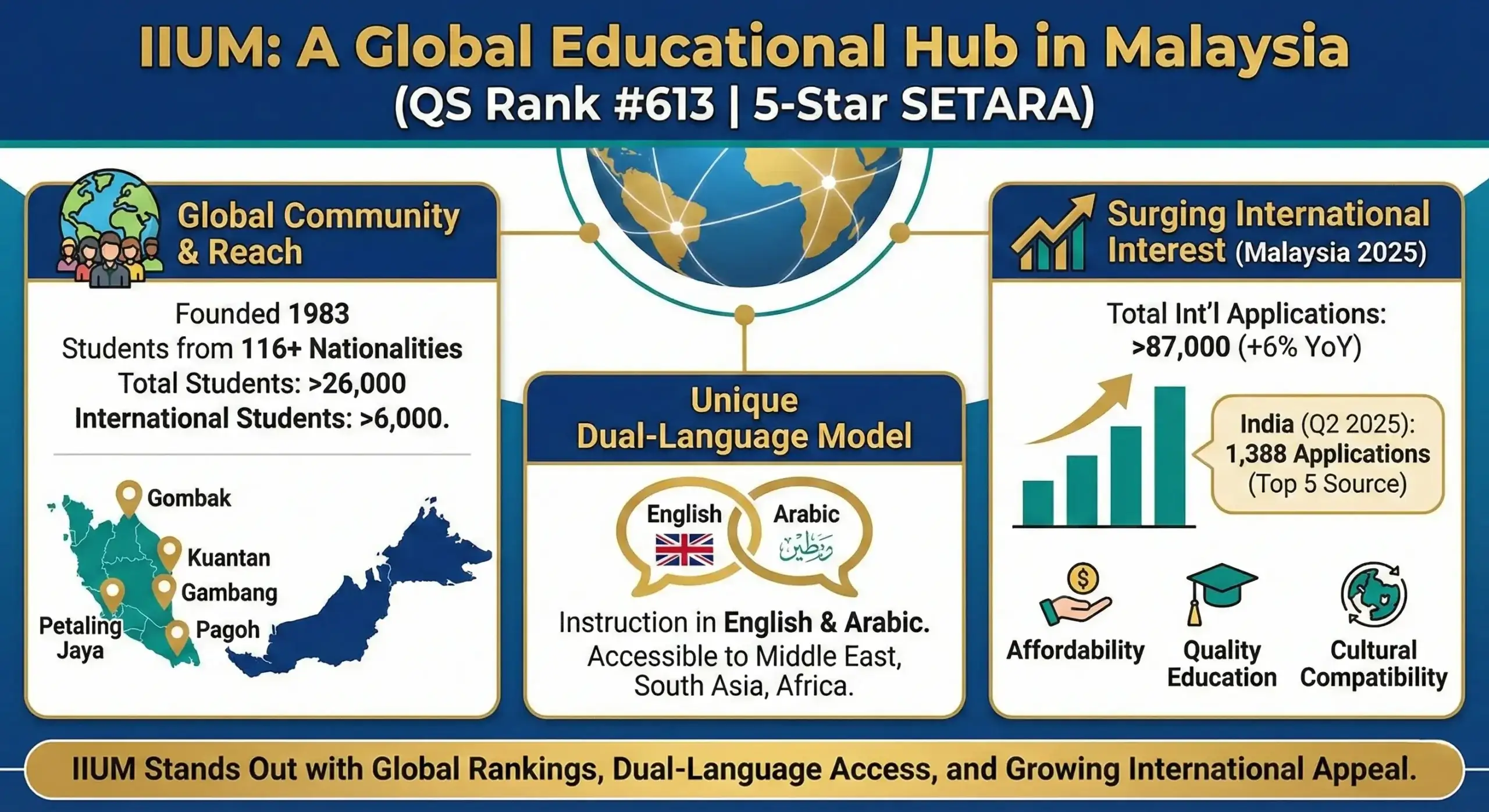 Before diving into the full IIUM course list, it’s worth understanding why this university attracts students from over 116 nationalities. Founded in 1983, IIUM holds a QS World University Ranking of #613 for 2026, placing it among the top universities globally. The university also carries a prestigious 5-star SETARA rating from the Malaysian government, which is the highest institutional quality benchmark in the country.
What truly sets IIUM apart is its dual-language instruction model. Unlike most Malaysian universities that teach primarily in Malay or English, IIUM courses are delivered in both English and Arabic, making them uniquely accessible to students from the Middle East, South Asia, and Africa. The university currently enrolls over 26,000 students, with more than 6,000 of them being international students spread across campuses in Gombak (Kuala Lumpur), Kuantan (Pahang), Petaling Jaya, Gambang, and Pagoh.
Malaysia itself is experiencing a surge in international student interest. According to Education Malaysia Global Services (EMGS), the country received over 87,000 international student applications in 2025, a 6% rise from the previous year. India ranked among the top five source countries with 1,388 applications in Q2 2025 alone, and that number continues to climb as students discover Malaysia’s combination of affordability, quality education, and cultural compatibility.
Complete IIUM Course List: All 14 Kulliyyahs Explained
IIUM organizes its academic departments into Kulliyyahs — the Arabic word for faculties. Each Kulliyyah operates with a degree of independence, offering its own undergraduate, postgraduate, and doctoral IIUM courses. Here is the full breakdown of every IIUM faculty and the course list available under each.
Ahmad Ibrahim Kulliyyah of Laws (AIKOL) — Gombak Campus
AIKOL was one of the original two faculties established when IIUM opened in 1983. It remains one of the most respected law schools in Southeast Asia, and its IIUM courses in law produce graduates who practice across Malaysia and internationally.
Programs offered include the Bachelor of Laws (LLB) Honours, Master of Comparative Laws (MCL), and PhD in Law. The LLB program integrates both civil law and Shariah law perspectives, giving graduates a distinctive edge in jurisdictions that operate dual legal systems.
Kulliyyah of Economics and Management Sciences (KENMS) — Gombak Campus
Also established in 1983, KENMS houses four departments covering Economics, Business Administration, Accounting, and Finance. The IIUM courses offered at the undergraduate level include the Bachelor of Economics, Bachelor of Business Administration, Bachelor of Accounting, and Bachelor of Finance.
At the postgraduate level, KENMS offers an MBA, Master of Economics, and specialized research degrees. If you’re an Indian student looking at IIUM as your study abroad destination, the accounting and finance courses are particularly popular given their alignment with international professional certifications.
Kulliyyah of Islamic Revealed Knowledge and Human Sciences (KIRKHS) — Gombak Campus
This is IIUM’s largest Kulliyyah by program count, spanning disciplines from Islamic studies to psychology, political science, communication, sociology, and English language. The undergraduate IIUM courses here include degrees in Fiqh and Usul al-Fiqh, Quran and Sunnah Studies, Psychology, Political Science, Communication, History and Civilization, English Language and Literature, and Arabic Language and Literature.
For students interested in the humanities and social sciences, KIRKHS offers a remarkably diverse IIUM course list that you won’t easily find at other Malaysian institutions.
Kulliyyah of Engineering (KOE) — Gombak Campus
Engineering is one of the most sought-after fields among international students, and IIUM’s Engineering Kulliyyah delivers across seven departments. The IIUM engineering course list includes undergraduate programs in Civil Engineering, Mechanical Engineering, Electrical and Computer Engineering, Chemical Engineering, Manufacturing and Materials Engineering, Mechatronics Engineering, and Aerospace Engineering.
All engineering IIUM courses are accredited by the Board of Engineers Malaysia and follow the Washington Accord, meaning your degree is recognized internationally. KOE also offers an integrated Bachelor-Master pathway for high-performing students who want to fast-track their postgraduate studies.
Kulliyyah of Architecture and Environmental Design (KAED) — Gombak Campus
Established in 1996, KAED is known for integrating Islamic design principles with contemporary architectural practice. IIUM courses in this Kulliyyah include the Bachelor of Science in Architectural Studies, Bachelor of Science in Quantity Surveying, Bachelor of Science in Urban and Regional Planning, and Bachelor of Landscape Architecture.
Students who complete the architectural studies degree can progress to the Master of Architecture, which is the professional qualification needed to practice as a registered architect.
Kulliyyah of Information and Communication Technology (KICT) — Gombak Campus
In a world increasingly driven by technology, KICT produces graduates equipped with both technical skills and ethical awareness. The IIUM course list for this Kulliyyah includes undergraduate degrees in Computer Science, Information Technology, and Library and Information Science.
KICT’s programs emphasize hands-on learning through industry internships, and the faculty maintains partnerships with tech companies across Southeast Asia. If you’re comparing technology programs across Malaysian universities, IIUM’s approach of combining technical rigor with values-based education is distinctive.
Kulliyyah of Education (KOED) — Gombak Campus
KOED prepares future educators and educational leaders through programs that blend modern pedagogy with Islamic educational philosophy. Undergraduate offerings include the Bachelor of Education in Teaching English as a Second Language (TESL), Guidance and Counseling, and Islamic Education.
The Kulliyyah also runs one of Malaysia’s most respected doctoral programs in education, attracting researchers from across the Muslim world.
Kulliyyah of Medicine (KOM) — Kuantan Campus
IIUM’s medical program is based at the Kuantan campus in Pahang, which provides access to dedicated clinical facilities. The MBBS (Bachelor of Medicine, Bachelor of Surgery) is a five-year program that combines conventional medical training with an emphasis on holistic healthcare.
The KOM has been producing doctors for over 24 years and its graduates are known for practicing what the university describes as holistic medicine. Entry requirements for international students include strong grades in Biology, Chemistry, and Physics at the A-Level or equivalent, along with the standard IELTS 6.0 or TOEFL 550 English proficiency requirement.
Kulliyyah of Dentistry (KOD) — Kuantan Campus
The Doctor of Dental Surgery (DDS) program runs for five years and is also based at the Kuantan campus. Like the medical program, it requires a strong science background for admission and maintains rigorous clinical training standards.
Kulliyyah of Pharmacy (KOP) — Kuantan Campus
Established in 2000, the Pharmacy Kulliyyah offers a Bachelor of Pharmacy (Honours) program along with Master and PhD research degrees with specializations in Pharmacy Practice, Pharmaceutical Chemistry, Pharmacology, and Pharmaceutical Technology.
Kulliyyah of Allied Health Sciences (KAHS) — Kuantan Campus
KAHS rounds out IIUM’s health sciences cluster in Kuantan. Undergraduate programs include degrees in Biomedical Science, Radiography and Diagnostic Imaging, Optometry, Nutrition Sciences, Audiology and Speech Language Pathology, and Physiotherapy.
Kulliyyah of Science (KOS) — Kuantan Campus
The science faculty offers undergraduate degrees in Biotechnology, Mathematical Sciences, Applied Chemistry, Physics, Marine Science and Technology, and Applied Plant Sciences. Each program runs for four years and includes laboratory and fieldwork components.
Kulliyyah of Nursing (KON) — Kuantan Campus
The Bachelor of Nursing (Honours) program is one of IIUM’s newer offerings. It was designed to address the growing demand for nursing professionals in Malaysia and across the region, with a curriculum that integrates both evidence-based nursing practice and patient-centered care principles.
Kulliyyah of Languages and Management (KLM) — Pagoh Campus
Located at IIUM’s Pagoh campus in Johor, KLM focuses on language education and tourism management. Programs include degrees in English for International Communication, Arabic for International Communication, and Tourism Management.
IIUM Admission Requirements for International Students
Getting into IIUM as an international student requires meeting both general and program-specific criteria. Here’s what you need to know:
For undergraduate admission, you’ll need a minimum of three principal passes at the GCE A-Level or equivalent qualifications recognized by IIUM’s Senate. Indian students with completed Plus Two (HSC) qualifications from recognized state or national boards are generally eligible to apply, though some programs may require the IIUM Foundation as a preparatory pathway.
English proficiency is mandatory for all English-medium programs. IIUM requires a TOEFL score of 550 or IELTS 6.0 with a minimum band of 5.5 in each skill. If you don’t meet this threshold, IIUM offers English language classes that you can complete before entering your degree program.
For medical and pharmacy programs, you’ll need strong grades specifically in Biology, Chemistry, and Physics or Mathematics. Engineering programs similarly require Physics and Mathematics at the advanced level.
Postgraduate applicants need a minimum CGPA of 2.75 for master’s programs and 3.00 for PhD programs, though requirements may vary by Kulliyyah.
IIUM Tuition Fees: What International Students Can Expect
One of Malaysia’s biggest advantages as a study destination is affordability. According to ICEF Monitor’s 2025 analysis, annual undergraduate tuition in Malaysia averages around USD 6,000 — significantly less than the US, UK, Canada, or Australia.
At IIUM specifically, course fees for international undergraduates generally range from RM 8,000 to RM 51,000 per year depending on the Kulliyyah and program. Medical and dental IIUM courses sit at the higher end, while humanities and social science courses are more affordable. The university also charges a one-time entrance fee, semester recurrent fees, and mahallah (hostel) fees of approximately RM 2,262.50 per semester for standard rooms.
One important note for 2025-2026: starting from September 2025, all IIUM invoices for international students now include applicable Sales and Service Tax (SST) charges on tuition and service-related fees, as mandated by Malaysian tax regulations.
How to Apply to IIUM: A Step-by-Step Process
The application process for IIUM courses works through the university’s e-Admission portal. Admissions typically open for three intake periods: Semester 1 (September), Semester 2 (March), and Semester 3 (June), though course availability varies by program.
Here’s what the process looks like in practice. First, you’ll submit your application through the IIUM portal along with certified copies of your academic transcripts, English proficiency test scores, and a processing fee of RM 424. Once your application is reviewed, successful candidates receive an offer letter. After accepting the offer, the university initiates your student visa process through EMGS (Education Malaysia Global Services), which coordinates with Malaysian immigration to issue your eVAL letter — the electronic approval you need to enter Malaysia as a student.
This is where many students feel overwhelmed, and it’s exactly the stage where working with a knowledgeable consultancy makes a massive difference.
As Syed Abdul Wadood, an IIUM student, shared about his experience:
- “From the moment I reached out, their team was insanely helpful. They handled everything smoothly, answered my endless questions, and took away all the stress I had around registration, course selection, and all those technicalities we international students struggle with.”
If you’re applying from India and want hands-on guidance through the entire journey — from choosing the right IIUM course to completing your visa and settling in on campus — Study Comet’s expert team specializes in exactly this. As official partners of IIUM, they offer end-to-end support that covers IIUM course selection, admission guidance, visa processing, pre-departure preparation, and even post-arrival assistance on campus.
Why Indian Students Are Choosing IIUM Courses in 2026
The trend of Indian students heading to Malaysia for higher education is accelerating. Malaysia’s affordability compared to traditional Western destinations, combined with globally ranked universities and a welcoming multicultural environment, makes it a compelling choice. IIUM in particular attracts Indian students for several reasons: its English-medium instruction, internationally accredited programs, affordable fee structure as a public university, and the comprehensive campus life that includes guaranteed accommodation for full-time undergraduate students across its 16 residential halls.
As one student, Aazima Basharat, described after finding Study Comet through Reddit:
- “They were kind enough to expedite my application process. Throughout the application screening, they were constantly in touch and kept me updated regarding any minute change in my application.”
She also noted that guidance extended well beyond admission to include visa processing, document checklists, and deadline reminders.
For students weighing IIUM courses against other top Malaysian universities like Taylor’s, Sunway, or APU, the deciding factors often come down to your preferred field of study, budget, and whether the values-integrated education model resonates with your goals.
Frequently Asked Questions About IIUM Courses
1. What courses does IIUM offer for international students?
IIUM offers over 50 undergraduate courses and numerous postgraduate degrees across 14 Kulliyyahs. The IIUM course list spans law, engineering, medicine, and pharmacy to computer science, architecture, education, humanities, and Islamic studies. All IIUM courses are open to international students who meet the admission criteria.
2. What is the language of instruction at IIUM?
IIUM uses English and Arabic as its primary languages of instruction, depending on the program. Most science, engineering, law, and business programs are taught in English, while Islamic studies programs may use Arabic. International students need a TOEFL score of 550 or IELTS 6.0 for English-medium programs.
3. How much does it cost to study at IIUM as an international student?
IIUM course fees for international undergraduates range from approximately RM 8,000 to RM 51,000 per year depending on the program. Hostel fees are around RM 2,262.50 per semester. Medical and dental programs are at the higher end, while arts and humanities courses are more affordable.
4. What is the IIUM QS World Ranking in 2026?
IIUM is ranked #613 in the QS World University Rankings 2026, placing it among the top 7.2% of universities globally out of over 8,400 institutions evaluated. It also holds a 5-star SETARA rating from the Malaysian Qualifications Agency.
5. Can Indian students apply directly to IIUM undergraduate programs?
Indian students with GCE A-Level equivalents or recognized pre-university qualifications can apply directly. Those with Plus Two qualifications may need to complete the IIUM Foundation program first. Working with Study Comet as your trusted study abroad partner can help you determine the right pathway based on your specific qualifications.
6. Does IIUM provide hostel accommodation for international students?
Yes, IIUM has practiced 100% accommodation for full-time undergraduate students since its early years. The university has 16 residential halls (mahallahs) that house approximately 14,000 students from diverse nationalities and cultural backgrounds.
Ready to explore the full IIUM course list and start your application?
Get in touch with Study Comet for free expert guidance on admissions, visa processing, and everything you need to begin your academic journey in Malaysia.