


Study in Malaysia requirements can feel overwhelming when you’re sitting in India trying to piece together information from a dozen different websites. From academic transcripts and English proficiency scores to visa paperwork and medical checks, the checklist is long — but it doesn’t have to be confusing. This guide breaks down every study in Malaysia requirement you need to know so you can move forward with confidence.
Malaysia has quietly become one of Asia’s most popular higher-education destinations, and for good reason. With globally ranked universities, English-taught programmes, and living costs that are a fraction of what you’d pay in the UK, US, or Australia, more Indian students are choosing Malaysia every year. But understanding the study in Malaysia requirements before you apply is what separates a smooth admission journey from a frustrating one. Let’s walk through the complete picture.
Why Malaysia Is Attracting Record Numbers of International Students
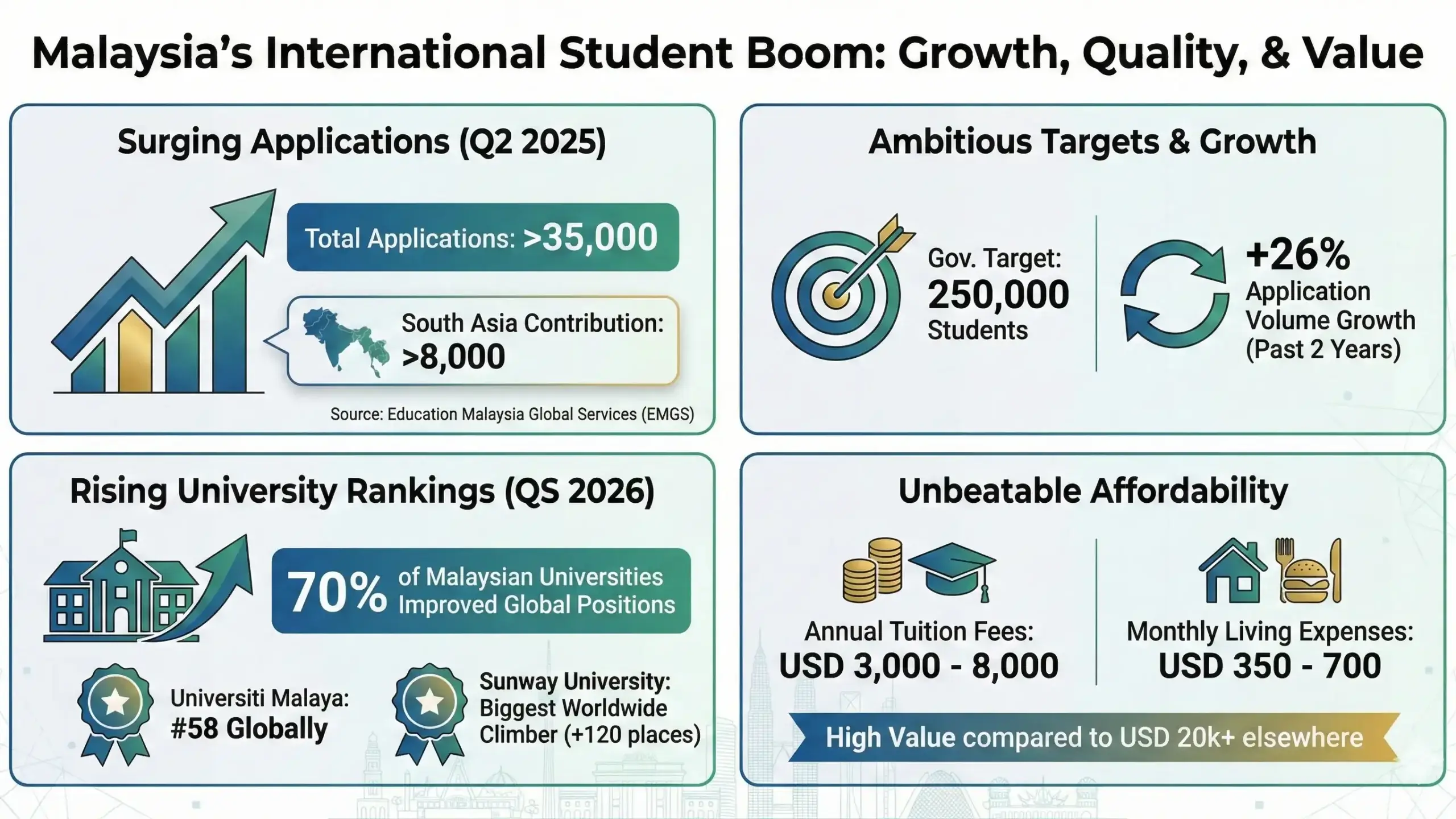
Before diving into the specific study in Malaysia requirements, it helps to understand why this country deserves your attention in the first place. According to Education Malaysia Global Services (EMGS), the government body managing all international student applications, the country received over 35,000 applications in Q2 2025 alone, with South Asia contributing more than 8,000 of those. The Malaysian government has set an ambitious target of hosting 250,000 international students, and application volumes have surged by roughly 26 per cent over the past two years.
What’s driving these numbers? In the QS World University Rankings 2026, 70 per cent of Malaysia’s 32 ranked universities improved their global positions — the highest improvement rate of any country with ten or more ranked institutions. Universiti Malaya sits at #58 globally, and Sunway University made headlines as the biggest climber worldwide, rising over 120 places.
Tuition fees for international undergraduates typically range between USD 3,000 and USD 8,000 per year, while monthly living expenses fall between USD 350 and USD 700. Compare that with annual tuition of USD 20,000-plus in Australia or the UK, and the value becomes obvious. Study Comet partners with many of these top-ranked institutions — you can explore all partner universities to find the right fit for your field and budget.
Academic Eligibility to Study in Malaysia
The academic study in Malaysia requirements will depend on the programme level you’re applying to. Each university sets its own admission criteria, but there are common benchmarks across the board.
Undergraduate Programmes
For a bachelor’s degree, Malaysian universities generally require completion of 10+2 (or equivalent) from a recognised board. Most institutions look for a minimum aggregate of 60–70 per cent, though competitive programmes in engineering, medicine, or business may set the bar higher. You will need to submit certified copies of your Class 12 mark sheets and school-leaving certificate.
Some universities also accept international qualifications such as A-Levels, the International Baccalaureate (IB), or Foundation programmes offered by the university itself. If your grades don’t quite meet the cut-off, a foundation year at a Malaysian institution can bridge the gap and provide conditional entry into your chosen degree. Meeting the study in Malaysia requirements for undergraduate admission is generally straightforward for Indian students who have completed their higher secondary education with decent marks.
Postgraduate Programmes (Master’s and PhD)
For a master’s degree, the study in Malaysia requirements typically include a recognised bachelor’s degree with a minimum CGPA of 2.5 on a 4.0 scale (or equivalent). Certain programmes — particularly MBAs — may also require relevant work experience or a GMAT score. PhD applicants need a master’s degree along with a research proposal and, in some cases, published academic work.
According to Times Higher Education’s application guide, specific prerequisite subjects may be required depending on your chosen field, so it’s worth confirming programme-specific criteria early.
If you’re an Indian student considering IIUM — one of Malaysia’s most sought-after public universities for international applicants — Study Comet offers dedicated support as an official partner. You can learn more about the admission process at IIUM directly on the Study Comet website.
English Language Proficiency Requirements
Since English is the primary medium of instruction at most Malaysian universities, proving your proficiency is one of the most important study in Malaysia requirements. The most commonly accepted tests and their typical minimum scores are:
IELTS (Academic): Most undergraduate programmes require an overall band of 5.0–6.0. Postgraduate programmes generally ask for 6.0–6.5. IELTS remains the most widely recognised test across Malaysian institutions.
TOEFL iBT: A score of 60–80 is standard for undergraduate entry, while postgraduate programmes may require 80 or above.
PTE Academic: Increasingly accepted, with scores typically in the 42–58 range for undergraduate admission.
MUET (Malaysian University English Test): Primarily used by public universities. International students who’ve previously studied in Malaysia may use MUET scores — usually Band 3 or 4 for undergraduate and Band 4 or 5 for postgraduate entry.
There are important exemptions worth knowing about. If your previous degree was completed entirely in English, many universities will waive the language test requirement — provided you can supply an official medium-of-instruction letter from your former institution. Some private universities, including Asia Pacific University (APU) and SEGi University, also offer internal English placement tests as an alternative pathway. Knowing these exemptions can simplify the study in Malaysia requirements significantly.
Documents You’ll Need for Your Application
Getting your paperwork in order early is one of the best things you can do to meet the study in Malaysia requirements without delays. The EMGS required documents page provides the official checklist, which generally includes:
- Completed application form from your chosen university
- Certified copies of all academic transcripts and certificates (translated into English if originally in another language)
- English language proficiency test score report
- A valid passport with at least 18 months of remaining validity (EMGS recommends 12 months beyond your programme duration)
- Passport-sized photographs (usually white background)
- A personal statement or statement of purpose (typically 500–800 words for postgraduate applicants)
- Letters of recommendation (usually one or two, from lecturers or employers)
- A research proposal (for PhD applicants)
- Health declaration or pre-departure medical report
For students from certain countries, EMGS may require copies of all passport pages rather than just the bio-data page. It’s one of those small details that can delay your application if missed — and exactly the kind of thing a knowledgeable consultancy can help you catch early. Fulfilling the document-related study in Malaysia requirements accurately the first time saves weeks of back-and-forth.
Student Visa (Student Pass) Requirements
The student visa is a critical part of the study in Malaysia requirements that every international applicant must complete. All visa applications must go through EMGS — no exceptions. You cannot apply for a student visa independently through an embassy; your university initiates the process on your behalf after issuing an offer letter.
Here’s the general visa process:
Step 1 — Receive your offer letter. Once you’ve been accepted, the university submits your visa application through the EMGS portal.
Step 2 — Submit supporting documents. These include your passport, academic records, offer letter, proof of financial capacity, a medical report, and a personal bond document signed by the university.
Step 3 — Obtain the Visa Approval Letter (VAL). EMGS processes your application and, upon approval, issues a VAL. According to ICEF Monitor, the visa approval rate in Malaysia is approximately 90 per cent, which is reassuringly high.
Step 4 — Travel and get your Student Pass endorsed. After arriving in Malaysia, you’ll have your Student Pass sticker placed in your passport, and you’ll receive an i-Kad — a biometric identity card for international students that serves as your day-to-day ID.
The personal bond is essentially a security deposit lodged by your university on your behalf. The amount is refundable upon completion of your studies, provided you haven’t violated any immigration laws.
This is the stage where many students feel overwhelmed.
Easha, a Study Comet student, described the experience:
“When I faced unexpected visa delays, I was extremely nervous. The Study Comet team went above and beyond — they reassured me, tracked my application, made necessary inquiries, and provided invaluable advice.”
That kind of hands-on support can make the difference between a stressful few months and a smooth transition.
Cost of Studying in Malaysia: What Indian Students Should Budget
Understanding the financial picture is a crucial part of meeting the study in Malaysia requirements. Here’s a realistic breakdown:
Tuition fees vary widely by institution and programme. At public universities, annual fees can be as low as USD 1,500–3,000 for postgraduate research programmes. Private universities range from USD 3,000–8,000 per year for most undergraduate courses, with medicine programmes reaching up to USD 15,000–25,000 annually.
Living expenses in Malaysia average around RM 2,500 per month (roughly INR 48,000–50,000), covering accommodation, food, transport, and utilities. According to the QS Best Student Cities index, Kuala Lumpur remains one of Asia’s most affordable student cities — and significantly cheaper than Singapore, Hong Kong, or any major Australian city.
Scholarships are available from both the Malaysian government and individual universities. The Malaysia International Scholarship (MIS) covers tuition and provides a living allowance for postgraduate students. Many private institutions also offer merit-based fee waivers of 10–50 per cent.
Study Comet can help you identify scholarship opportunities that match your profile. Visit the Study Comet FAQ page for answers to common questions about funding and financial planning.
How Study Comet Makes the Process Easier
Navigating admission requirements Malaysia universities set, managing visa paperwork, and relocating to a new country involves dozens of moving parts. That’s where having a dedicated consultancy partner changes everything.
Study Comet is an official partner of institutions including IIUM, APU, Taylor’s University, and the University of Cyberjaya, among others. Their support covers the entire journey — from shortlisting universities and submitting applications to visa processing, pre-departure checklists, and on-ground settling-in support after you arrive.
Syed Abdul Wadood, an IIUM student, put it this way:
“It felt like talking to seniors who genuinely wanted me to succeed — not just a business. They handled everything smoothly, answered my endless questions, and took away all the stress.”
Aazima, who discovered Study Comet through Reddit, highlighted the ongoing communication:
“Throughout the application screening, they were constantly in touch and kept me updated regarding any minute change. They even guided me through the visa process and e-val.”
Whether you’re just beginning to explore your options or you’ve already narrowed down your university shortlist, getting in touch with Study Comet is a smart first step.
Frequently Asked Questions About Study in Malaysia Requirements
1. What are the basic study in Malaysia requirements for Indian students?
You’ll need to have completed 10+2 (for undergraduate) or a bachelor’s degree (for postgraduate), English proficiency proof (IELTS 5.0–6.5 or equivalent), a valid passport with 18+ months validity, and financial documentation. Your university and EMGS handle the visa process once you’ve secured admission.
2. Is IELTS mandatory to study in Malaysia?
Not always. Several universities accept alternative tests like TOEFL, PTE, or their own internal English assessments. If your prior education was conducted entirely in English, you may qualify for a waiver — check with your chosen institution.
3. How much does it cost to study in Malaysia from India?
Annual tuition ranges from approximately INR 2 lakh to INR 9 lakh for most undergraduate programmes. Monthly living costs average around INR 48,000–50,000. Overall, Malaysia is significantly more affordable than Western study destinations.
4. How long does the Malaysian student visa take?
Processing times vary, but most Student Pass applications through EMGS take four to eight weeks. Having complete, error-free documentation that meets all study in Malaysia requirements speeds up the process considerably.
5. Can international students work while studying in Malaysia?
Yes, but with restrictions. International students can work part-time up to 20 hours per week during semester breaks and holidays. You cannot work during active semester periods without specific university approval.
6. What is the best time to apply for Malaysian universities?
Malaysia has three main intakes — February (Spring), July/August (Fall), and November (Minor). The February and July intakes typically have the most available seats. Start preparing your documents at least six to nine months before your target intake.
Ready to begin your study abroad journey?
Contact Study Comet for free, expert guidance from application to arrival — and beyond.